


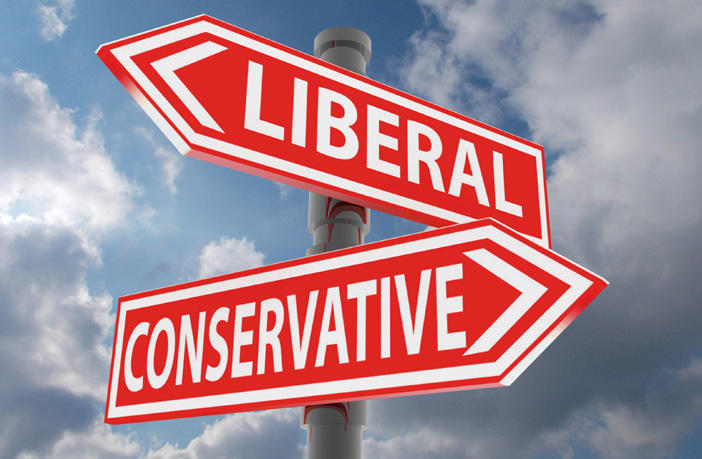
How people understand “liberal” and “conservative” varies dramatically by country**. The meanings aren’t universal. What counts as “liberal” in the U.S. might be seen as moderate or even conservative elsewhere — and vice versa.
Let’s break it down clearly.
---
### 🌍 1. **The U.S. View (Familiar but Narrow)**
In **American politics**, the terms are deeply tied to the two-party system:
| Term | U.S. Meaning |
|------|------------|
| **Liberal** | Generally supports government action to promote social equality, civil rights, environmental protection, and healthcare access. Often associated with the Democratic Party. |
| **Conservative** | Favors limited government, free markets, traditional values, strong national defense, and individual responsibility. Often linked to the Republican Party. |
👉 In the U.S., “liberal” is **left-of-center**, not far-left.
And “conservative” is **right-of-center**, not extremist.
But this is just *one* version — and it doesn’t translate directly elsewhere.
---
### 🌐 2. **In Other Countries: The Labels Shift**
#### 🇬🇧 **United Kingdom**
- **Liberal** = Historically pro-free markets and individual liberty.
- The **Liberal Democrats** are centrist, pro-EU, and socially progressive — but not “liberal” in the American sense.
- **Conservative** = The **Conservative Party** (Tories) supports free markets, national tradition, and Brexit — but still operates within a strong welfare state (like the NHS).
- A U.S. liberal might find UK Conservatives too right-wing — but UK voters see them as mainstream.
👉 **Key difference**: In the UK, even conservatives accept universal healthcare — something often debated in the U.S.
---
#### 🇨🇦 **Canada**
- **Liberal Party** = Center-left. Supports multiculturalism, climate action, and modest government intervention.
- **Conservative Party** = Center-right. Pro-business, but still supports public healthcare and social safety nets.
👉 A U.S. conservative might see Canadian conservatives as “liberal” — because they accept higher taxes and social programs.
---
#### 🇩🇪 **Germany**
- **Liberal** = The **Free Democratic Party (FDP)** is classically liberal — meaning **pro-free market, pro-business, and pro-individual rights** — but not necessarily “progressive” on social issues.
- **Conservative** = The **Christian Democratic Union (CDU)** blends traditional values with support for the welfare state and European integration.
👉 Here, “liberal” often means **economic freedom**, not social liberalism.
---
#### 🇦🇺 **Australia**
- **Liberal Party** = Actually **center-right** — supports free markets and business interests. Despite the name, it’s not “liberal” in the U.S. sense.
- **Labor Party** = Left-of-center, supports workers’ rights and public services.
👉 The name “Liberal Party” confuses Americans — because it’s conservative in practice.
---
#### 🇮🇳 **India**
- **Liberal** = Often means **secular, progressive, pro-free speech, and critical of religious nationalism**.
- **Conservative** = Often aligned with **Hindu nationalism (e.g., BJP)**, traditional social roles, and strong national identity.
👉 Here, the divide is more **cultural and religious** than economic.
---
#### 🇮🇷 **Iran (for contrast)**
- **Liberal** = Extremely rare in official discourse. Would mean someone who wants democracy, free press, women’s rights — and could be jailed for it.
- **Conservative** = Supports the Islamic Republic, religious law, and traditional values.
👉 In authoritarian states, “liberal” isn’t just a political label — it can be a **dangerous identity**.
---
### 🧠 Why the Confusion?
The problem is:
👉 **“Liberal” and “conservative” mean different things depending on context.**
| Factor | How It Changes the Meaning |
|-------|-----------------------------|
| **History** | In 1800s Europe, “liberal” meant pro-free market, anti-monarchy — very different from today. |
| **Welfare State** | In countries with strong public healthcare (UK, Canada), even conservatives accept it — so the debate starts from a different place. |
| **Religion** | In the U.S., abortion and religion are central. In secular France, they’re less political. |
| **Economic System** | In socialist-leaning countries, “conservative” might just mean “less socialist,” not anti-government. |
---
### 🎯 Key Takeaway
> **“Liberal”
and “conservative” are relative — not absolute.**
They don’t describe fixed ideologies.
At their **core**, the words *liberal* and *conservative* come from broad ideas:
- **Liberal** → from Latin *liberalis*, meaning "free" — historically linked to **freedom, openness, progress, and change**.
- **Conservative** → from *conservare*, "to preserve" — tied to **tradition, stability, and continuity**.
So yes — in theory:
> 🔹 **Liberal = change**
> 🔹 **Conservative = tradition**
But here’s the catch:
👉 **What counts as “change” or “tradition” depends entirely on *where* and *when* you are.**
Let’s dig into why that matters.
---
### 🌍 1. **Tradition Isn’t Universal — It’s Local**
What one country sees as “traditional,” another sees as outdated — or even oppressive.
| Country | “Traditional” Values | Notes |
|--------|------------------------|-------|
| **United States** | Free markets, gun rights, nuclear family, patriotism | Seen as foundational |
| **Sweden** | Equality, consensus, secularism, strong welfare state | These are *their* traditions |
| **Japan** | Respect for elders, group harmony, imperial heritage | Deeply cultural |
| **Saudi Arabia** | Religious law, gender roles, monarchy | Enforced as national identity |
👉 So a “conservative” in Sweden supports strong social programs — because that’s what’s **traditional there**.
But a U.S. conservative might see that as “liberal.”
Same label.
Different reality.
---
### 🔁 2. **Change Is Relative**
“Change” only makes sense when you ask:
> *Change from what?*
| Country | What “Change” Means |
|--------|----------------------|
| **U.S.** | Expanding LGBTQ+ rights, racial justice, climate action → seen as “liberal change” |
| **Russia** | Any challenge to state power or traditional values → seen as dangerous “Western liberalism” |
| **South Korea** | Young people rejecting rigid work culture → “liberal” shift |
| **Brazil** | Indigenous rights, environmental protection → progressive “change” vs. conservative agribusiness interests |
👉 In some places, “liberal change” is normal evolution.
In others, it’s seen as **threatening national identity**.
---
### 🧩 3. **The Same Person Can Be Both — Depending on Context**
Think of it like this:
A person can be:
- **Economically conservative** (wants low taxes, small government)
- But **socially liberal** (supports abortion rights, LGBTQ+ marriage)
- Or vice versa
And in different countries, these combinations shift.
**Example: Australia**
- The **Liberal Party** is *economically conservative* — pro-business, lower taxes.
- But many of its voters are *socially moderate or even progressive*.
- Despite the name, it’s not “liberal” in the American sense.
👉 So the label “liberal” doesn’t tell you much — unless you know the context.
---
### 🕰️ 4. **Over Time, “Change” Becomes “Tradition”**
What was once radical becomes normal.
| Once “Liberal” (Change) | Now “Conservative” (Tradition) |
|--------------------------|-------------------------------|
| Civil rights in the U.S. (1960s) | Now seen as foundational by most |
| Women voting (early 1900s) | Now unquestioned tradition |
| Internet freedom (1990s) | Now expected — even “traditional” |
👉 Today’s “radical change” can become tomorrow’s “cherished tradition.”
Which means:
> A true conservative might unknowingly defend ideas that were once considered dangerously liberal.
---
### 🎯 Final Thought
Yes — **liberal means change, conservative means tradition**.
That’s the **dictionary definition**.
And it’s a good starting point.
But in real life:
- **Change** is just yesterday’s tradition.
- **Tradition** is just frozen change.
And **what counts as “normal”** depends on:
- Where you live
- What generation you’re in
- What history you’ve lived through
So the real question isn’t:
> “Are you liberal or conservative?”
It’s:
> “**What world do you consider normal — and what world are you fighting to keep or change?**”
Because in the end,
we’re all trying to protect something:
👉 A future we believe in —
or a past we miss.
And that’s what really drives the divide.
--
The origin of **"left" and "right"** in politics is one of the most influential accidents in history. It started not with a revolution of arms, but with **a seating chart**.
Let’s go back to **France, 1789** — the birthplace of modern left and right.
---
### 🇫🇷 The French Revolution: Where "Left" and "Right" Were Born
In **May 1789**, King Louis XVI called a meeting of the **Estates-General** — a rare assembly meant to address France’s financial crisis. It was made up of three estates:
1. **The Clergy** (First Estate)
2. **The Nobility** (Second Estate)
3. **The Commoners** (Third Estate)
But tensions were high.
The Third Estate — representing 98% of the population — demanded more power.
When they were ignored, they broke away and formed the **National Assembly**, swearing the **Tennis Court Oath** — vowing not to disband until France had a constitution.
By **1791**, the National Assembly had a permanent meeting hall.
And how they sat — **literally** — gave us the terms we still use today.
---
### 🪑 The Seating Chart That Changed History
In the assembly hall, members chose where to sit based on their views:
| Side of the Hall | Who Sat There | Political Lean |
|------------------|--------------|----------------|
| **Right Side** 🪑 | Supporters of the **King**, **aristocracy**, and **Catholic Church** | Wanted to **preserve** the monarchy and traditional order |
| **Left Side** 🪑 | Revolutionaries, radicals, reformers | Wanted to **abolish** the monarchy, create equality, and build a republic |
👉 Over time, people started referring to:
- **"The Right"** — those who wanted to **conserve** the old system.
- **"The Left"** — those who wanted **change**, **reform**, or even **revolution**.
Thus, **"left" = progressive**, **"right" = conservative** — born not from theory, but from **real estate**.
---
### 🔥 The Ideals Behind the Divide
As the Revolution unfolded, the split deepened:
#### ✅ **The Left (Radicals & Reformers)**
- Supported:
- Ending monarchy
- Equality before the law
- Secularism (separating church and state)
- Rights for common people
- Key figures:
- **Maximilien Robespierre** (Jacobins)
- **Georges Danton**
- **Jean-Paul Marat**
They wanted to **tear down the old world** and build a new one based on **liberty, equality, fraternity**.
#### ✅ **The Right (Monarchists & Traditionalists)**
- Supported:
- Keeping the king
- Preserving noble privileges
- Upholding the Catholic Church’s authority
- Believed:
- Order and tradition were essential
- Rapid change would lead to chaos
They feared the revolution would destroy society.
---
### ⚖️ The Evolution After the Revolution
The left-right divide didn’t end in 1791. It evolved:
| Period | Shift |
|-------|------|
| **1793–1794 (Reign of Terror)** | The Left went extreme — executing the king, purging enemies. Even moderates on the left were killed. |
| **Post-Revolution** | The terms stuck. "Left" meant reform or revolution. "Right" meant order, tradition, monarchy. |
| **19th Century** | As monarchies faded, the meaning shifted:
- **Left** = republicanism, workers’ rights, socialism
- **Right** = nationalism, capitalism, authoritarianism |
| **20th Century** | The divide globalized:
- **Left** = labor movements, civil rights, welfare states
- **Right** = free markets, anti-communism, traditional values |
---
### 🌍 Why This Matters Today
That **1789 seating chart** still shapes how we see politics — even in countries that never had a French-style revolution.
- In the **U.S.**, Democrats are "left," Republicans "right" — even though the U.S. didn’t have a monarchy to overthrow.
- In **India**, "left" means secular socialism; "right" means Hindu nationalism.
- In **Brazil**, "left" means Lula-style populism; "right" means Bolsonaro-style conservatism.
👉 But the core idea remains:
> **Left = change**
> **Right = tradition**
Even if **what** we’re changing or preserving is totally different now.
---